

Start Taking Security Seriously Again
Toto' Lab’s deployable system TSSA™ is a Zero Trust secure transport platform designed to protect communications across IT, OT, ICS, and cyber-physical environments where exposure of the network itself creates risk.
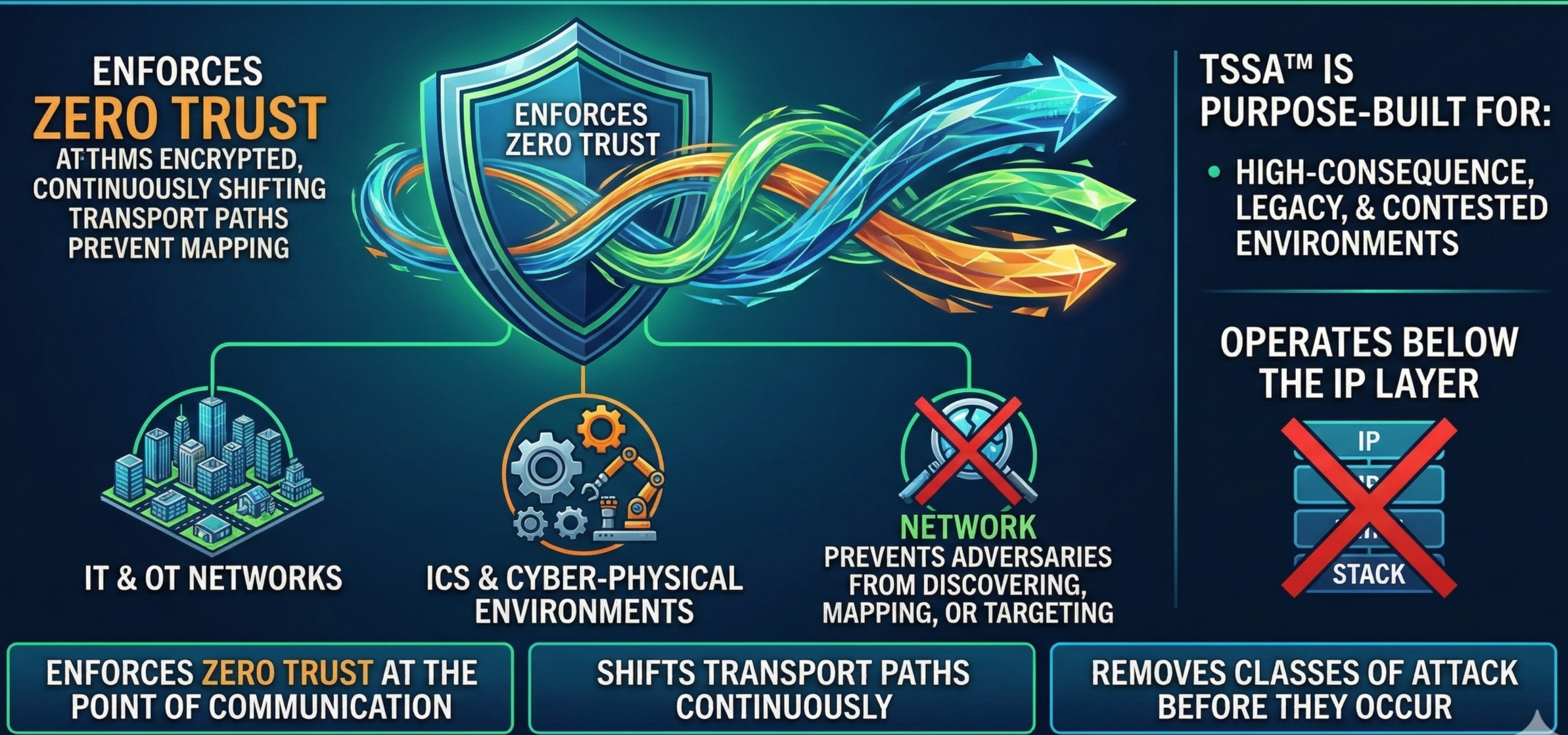
While many Zero Trust platforms focus on governing assets and access decisions, TSSA™ enforces Zero Trust at the point of communication, ensuring that systems can only connect through encrypted, policy-controlled, and continuously shifting transport paths. By operating below the IP layer, TSSA™ prevents adversaries from discovering, mapping, or targeting the network (removing entire classes of attack before they can occur).
TSSA™ is purpose-built for high-consequence, legacy, and contested environments where traditional perimeter defenses, VPNs, and static network architectures are insufficient.
-
TSSA™ secures communications by removing the static network characteristics that adversaries rely on to observe, map, and exploit systems. Rather than exposing fixed IP addresses, ports, or routes, TSSA™ continuously rotates network identifiers and cryptographic material as communications occur. Each connection is established with unique, short-lived parameters that exist only for the duration of the session and are discarded immediately afterward.
This ephemerality fundamentally changes the attacker’s problem. Because network attributes are constantly shifting, the topology cannot be reliably mapped, communications cannot be correlated over time, and previously observed paths provide no advantage for future access. There is no stable attack surface to probe, no address space to enumerate, and no persistent route to target.
By preventing reconnaissance and attribution at the outset, TSSA™ moves security enforcement upstream—away from detection and response after exposure, and toward proactive denial before an attacker can gain situational awareness of the network.
-
TSSA™ protects communications at OSI Layer 2, encrypting individual frames before they are processed or exposed at higher layers of the network stack. Encryption is applied using per-session, per-device, and per-direction cryptographic keys, ensuring that each communication path is isolated and independently protected.
Operating at the frame level allows TSSA™ to secure not only data payloads, but also network metadata, topology information, and protocol behavior that are typically visible and exploitable at Layer 3 and above. Each frame is validated for integrity and authenticity, preventing replay, tampering, or manipulation before it can affect connected systems.
Because enforcement occurs below the IP layer, TSSA™ remains effective even if higher-layer controls are misconfigured, bypassed, or unavailable. This provides a resilient foundation for secure communications, particularly in legacy or high-consequence environments where traditional defenses may be incomplete or inconsistent.
-
TSSA™ establishes Zero Trust connectivity without extending network visibility or creating implicit trust zones. Unlike VPNs, which expose internal networks and rely on static tunnels, TSSA™ creates direct, policy-enforced point-to-point connections between authorized devices only.
Each connection is explicitly authorized, cryptographically bound, and limited in scope and duration. Devices are never granted broad network access, and internal addressing is never revealed. Communication exists only where policy permits it, and only for as long as it is required.
Unknown or unauthorized devices are denied before any connection is established, with traffic dropped and logged without exposing the network. The result is a communication model that eliminates flat networks, reduces blast radius, and enforces Zero Trust principles at the moment of connection rather than after access has already been granted.

Let’s Work Together
If you're interested in working with us, complete the form with a few details about your project. We'll review your message and get back to you within 48 hours.